Journey:
Maybe the worst journey ever. The bus was about 12 hours and there was only one option leaving at 09:00 for a mere S.30. However, we made the poor decision to drink numerous Pisco sours the night before which meant the whole bus journey felt like death. Actual death.
Accommodation:
Atawkama Hostel. Not the best hostel. Cusco was very cold and the hostel had a kind of open backyard area where the rooms were. This meant the rooms were very cold as there was very little between them and the outside.
Sights/activities:
To visit most of the archaeological sites in Cusco you need an official tourist ticket. This costs S.130 and includes entry into 17 sites (to use within 10 days.) You can’t visit any of the sites without this ticket (or buying the partial one day ticket for S.70.) We saw a lot of ruins in Cusco so I’ve separated them up into sights within Cusco, around Cusco and in the Sacred Valley.
In Cusco:
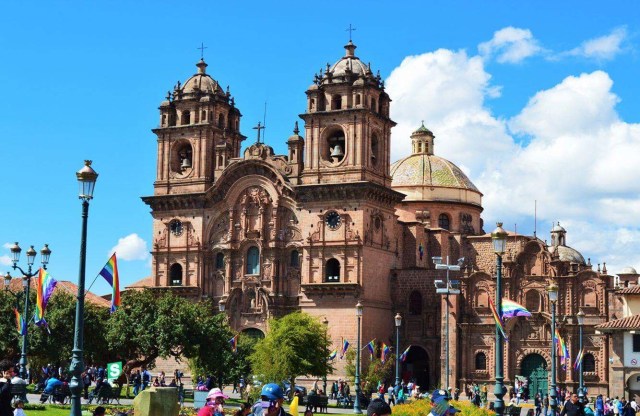
Plaza de Armas
Another beautiful central square, with some impressive architecture. Lots of the rainbow coloured Tahuantinsuyo flags decorate the square.
Choco Museo
It’s free. There’s also free chocolate. They’re meant to be samples. We just took handfuls. Oops.
Qorikancha
Inca ruins right in the centre of the city. We walked past the entrance for this several times – basically Qorikancha is also the convent of Santo Domingo. Qorikancha was the richest temple of the Inca Empire and some of the stonework still remains, later on the Santo Domingo convent was built over the top. This is not included in the tourist ticket but it’s still worth paying for this.


Iglesia de San Blas
Walk uphill to find this church and square. The church itself was pretty but not overly impressive (i.e. not worth paying for) but the square and streets surrounding it are some of the nicest in Cusco. Watch out for the famed inca street with the 12 sided stone.


Around Cusco:
To see the sites around Cusco we got a taxi for S.20 to the furthest site of Tambomachay and from there walked to Puca Pucara, Sacsayhuaman, Cristo Blanco and Q’enko before making our way back down into the city.
Sacsayhuaman
Most likely to have been a ceremonial centre with areas dedicated to the moon, lightning and stars. Some people argue though that it was a fortress due to the huge rocks that form a sort of zig zag wall (and I do mean absolutely huge rocks – see pictures.) The Spanish eventually captured Sacsayhuaman and after this battle the Incas were basically defeated and fled to the jungle. Check out the slides made of rock and the tunnels. There are a few tunnels remaining at this site which were thought to link throughout Cusco and other areas of the Inca Empire. Try and get through them without using a light – it’s a real challenge.


Q’enko
Believed to be a place where sacrifices and mummifications took place. There is an altar underneath the rocks that’s the most interesting point.
Puca Pucara
Situated on a hill overlooking the valley. This was thought to be a checkpoint where travellers may have stayed before entering or leaving Cusco, as well as a military and administrative centre. It is translated as the Red Fort due to the reddish colour of the bricks.


Tambomachay
A site for ritual bathing, most likely for just the use of the nobility. Not many people seemed to visit here at all, but perhaps not the most interesting of the ruins.


Cristo Blanco
A mini Christ the Redeemer this was actually a gift from Arabic Palestinians who took refuge in Cusco during World War II and towers over the city at about 8m high. Worth combining with a visit to Sacsayhuaman as they are right next door to each other. There’s great view over Cusco from here.


Sacred Valley:
To see the sacred valley ruins we opted to use a tour company as the only other way to see them would be to hire a taxi (which would have been too expensive.) This cost us S.48 and included a guide which was quite useful as he provided some good information. Salinas de Maras was not included in the tourist ticket and cost S.10.
Salinas de Maras (salt mines)
The locals run water into the pools, then drain it and the remaining water in the bottom is left to evaporate. Salt is then left behind. This process takes about a month. There are approximately 3000 pools here and it’s quite an impressive sight. The Incas were using this same technique hundreds of years ago at these salt mines in order to produce salt.


Moray
This was sort of an agricultural testing centre where the Incas tested various crop growing techniques due to the different levels they could test which crops grew better at which climates. (The deepest part being the hottest and the temperature dropping as the circles moved outwards.)


Ollantaytambo
This was believed to have once been a country retreat for the Inca nobility and royals. It was also the scene where some of the last battles between the Inca and Spanish took place. Opposite the ruins is a large mountain with the face of a warrior (which is actually quite easy to spot). The mountains were of huge spiritual importance to the Incas who believed them to be very much alive.


Pisac
It is uncertain what the exact function of Pisac was but there are examples of all types of architecture. There are a huge amount of terraces here for agricultural purposes. There are temples at the top of the complex suggesting it was used for religious reasons, and imperial architecture indicates it was maybe a royal residence too. However, it is thought to have originally been used as a military garrison.
One of the most interesting points here is to the West lie a lot of holes in the mountainside, which doesn’t seem overly exciting, but these were used to house mummies – about 3500 (who were treated by the Inca people as if they were alive – they were fed and looked after as if they were still human.) This is one of the largest Inca ruins and whilst at Machu Picchu you have another 2500 people to contend with, here there were maybe another 100 or less.


Food:
Quinoa everything.
We found the best restaurant selling quinoa burgers for S.10. They were amazing. Unfortunately, on our last day they were closed which meant we were hugely disappointed and spent an hour wandering around Cusco trying to find a replacement quinoa burger.


Summary:
Peru had just got better and better. Cusco is steeped in history and the ruins surrounding Cusco and lining the sacred valley are hard to forget (whilst they’re not Machu Picchu they still show off the Inca people’s impressive architect skill.)
Also, a point to note, the rainbow flag is the Inca flag not the gay pride flag (as we mistakenly thought.) One other fun fact -although I’ve referred to the people as Inca, this is not strictly correct. The Inca were actually just the Kings, the people should be referred to as Quechua.
 Wizz round the world