Huanchaco and the ruins of Chan Chan

Journey:

We took another overnight bus to do the journey from Mancora to Trujillo. It cost only S.45 each and we were told it would take about 8 hours (it didn’t, 11 hours is more accurate.) This time the company was El Sol and the bus was definitely less luxurious than our last journey, but then again the price was a whole lot cheaper. After reaching the city of Trujillo we then took a taxi for S.25 to get to the beach town of Huanchaco, which was half an hour away.

Accommodation:

Frog’s Chillhouse Hostel. A really nice hostel overlooking the beach (we could see the sea from our room.) There’s a big kitchen and lots of communal areas. Also, they have loads of bikes you can use for free. Best bit: a lot less crickets. I mean there were still crickets and all but there were so much less.

Sights/activities:

Surfing

Another Peruvian surf town. The good thing about surfing in Peru is that the waves are fairly consistent. However, the downsides were that it was definitely wetsuit temperature; and also, the water was pretty dirty (Thomas picked up a stomach bug – most likely from the state of the sea water here.)

Chan Chan

The ruins of Chan Chan are located 15 minutes away. We took one of the many red buses circling Huanchaco – Trujillo and it cost us S.1.50 each. They dropped us at the ‘entrance’ and then there was quite a long walk to get to the actual entrance, maybe a 1.5km stroll into the middle of the desert (or so it felt like.) It cost us S.10 each to enter the Tschudi complex or Palacio Nik-An (the only one of the nine palaces are open to the public) but there had been some flood damage so not all of the ruins were open.

In short, Chan Chan had been the capital of the Chimu kingdom and about 600 years ago had been the largest city in the Americas, and largest adobe city on Earth (city made of mud bricks.) In 1470 Chan Chan was invaded by the Incas, and many of Chan Chan’s workers were brought to their own capital – Cusco. More recently, rainfall has led to the collapse of the remaining structures and although a roof covers a short section the city covers about 20km square and so at the moment it is currently dissolving from bricks to mud.

The ticket also includes entrance into three other sites. To do these we paid a taxi S.45 to take us to each and drop us off at our hostel in Huanchaco at the end. (I’m sure you could maybe do this using buses or something but I wouldn’t have a clue where to start with this.) These three other sites are: the museum and two temples. The museum is definitely not worth going to and the temples are very similar to Chan Chan, but are still interesting to look at as they’re free. (I wouldn’t pay for them separately though.) We also saw our first Peruvian hairless dog here, which I thought was quite cute and Thomas thought was disgusting.

Food:

In Huanchaco there are places doing the usual set meal (starter/main/drink) for S.15 (but you can negotiate them down to S.10.) Most of the time the starter will be ceviche (lemony raw fish with salad) which we’d tried in Colombia too and it’s surprisingly yummy. Also, this is the first time we encountered Inca Kola which is kind of like a cream soda, and found all over Peru. It’s another one of those surprisingly yummy finds.

Summary:

Huanchaco was a massive step up from Mancora. There were far fewer crickets for one and although it was only a small fishing village there was still more to see than Mancora. I wouldn’t go to this area especially to see the ruins of Chan Chan but if you’re there it’s definitely worth a visit. It wasn’t my favourite place so far in our travels but the town definitely had a little charm and was restoring my fairly negative view of Peru so far.


Mancora and the cricket invasion

Journey:

We took our return flight from the Galapagos and went straight to the bus station (which is basically opposite the airport but still cost $4 for some reason.)

We then had about a 5 hour wait for our overnight bus to Mancora. We travelled with SuperCiva and it was absolute luxury (although the ticket price reflected that.) We got given snacks, the seats were absolutely huge and reclined all the way down, there was so much space. It was amazing.

However, not so amazing when we were woken at 1am at the Peru border. It took us about 2 hours for everyone on the bus to be stamped through the Ecuador exit and Peru entrance (which was admittedly quicker than the Ecuador/Colombia border.) When we were finally through we had another few hours sleep before we arrived in Mancora at 5:30am.

Accommodation:

Misfit Hostel

This hostel was located right on the beach and we had our own personal beach hut with a bathroom on the first floor and bedroom with a little balcony on the second floor. It sounds ideal right? Wrong. Queue massive long rant…

1) The first thing I noticed (although Thomas couldn’t ever smell it so thinks I’m crazy here) was the ever present smell of drains.

2) The breakfast (which was pathetically tiny) was eaten surrounded (and I mean surrounded) by flies and an assortment of other insects.

3) None of the toilets worked

4) The showers were all salt water (what’s the point? You might as well just go for a swim in the sea.)

However, this would all have been bearable but for the cricket issue. There were hundreds and hundreds of crickets in the little beach house we were staying in. If you stood up you would immediately get hit by two jumping around so the only way you could stay in the room was hiding under the mosquito net around the bed (although this didn’t completely stop them coming and joining you in the bed.) After this we decided to leave and move elsewhere. We had to pay 3 nights stay still when we had only stayed for 1 but this was worth it so long as we didn’t have to sleep with a thousand crickets again.

Kites Hotel

Our second hotel in Mancora was a hundred times nicer than the first. Originally it was going to cost us S.120 (roughly $36 per night) but as they obviously would rather have a room filled than nobody in and it was low season they gave it to us for S.80 ($24) instead. It had a swimming pool, toilets that worked, and best thing of all it had only a small amount of crickets. Crickets were unavoidable in Mancora but in this hotel there were maybe 10 in our room per night instead of 100 (except on the last night which I will forever remember as the invasion of the crickets – more to come later.)

Sights/activities:

Surfing

This is genuinely the only activity to do here, other than relaxing on a beach (not an issy friendly activity due to the massive risk of sunburn.) There’s a really nice left wave which is good for beginners and the more experienced. However, this is also the downside, with at least 15 people in the water at all times competing for the same wave it means you struggle to catch a lot of waves. Also, be warned the locals think that the waves should be theirs alone and are not the friendliest.

Food:

We basically went to the same place for lunch/dinner every day. Just off from the beach on the left hand side there is a restaurant and they do a lunch menu (starter/main/drink) for S.10. The tequenos (I just asked Thomas how to describe these and he said cheese pastry things but I can’t think of a better description myself) were my favourite option for the starter. In the evening everywhere does barbecues for again S.10.

For dessert (finding good dessert is the most important thing by far) we found somewhere on the Main Street (just next to the road going to the beach.) There was a little cart selling tea/coffee and a variety of cakes called Cafe Carola and we ate a large amount of their passion fruit pie which was amazing. (We came there so much they recognised us by the end and gave us some free pie.)

Summary:

If I was returning to Peru I would definitely give Mancora a miss. It’s a fairly average town without much personality and the inhabitants are generally quite unfriendly and don’t particularly like tourists. The beach is fine and the surfing is good fun (when you actually manage to catch a wave amongst the many surfers.)

The main downside for me was the huge amount of crickets. As I had said before we moved out of our first hostel due to the amount of crickets in our room; well on the last night there were crickets absolutely everywhere in this town. They lined the streets everywhere and were in every single restaurant and shop. There was no escaping them and there must have been millions in the town. I have no idea why/where they were from but I will always remember Mancora as the town that was invaded by crickets.

The Galapagos on a budget: San Cristobal

Journey:

All the boat tickets between islands are $30 one way. We chose to take the 7am boat to San Cristobal from Santa Cruz, which took about 2 hours and was over some quite choppy water. They cram a lot of people into the boat so definitely try and get a space at the back as it’s a lot less claustrophobic (and thus you are less likely to get seasick.)

Accommodation:

Casa de Jeimy. A really good hostel, the staff were very friendly and gave us advice on what to see/do on the island. It also has a terrace on the top floor with hammocks and a kitchen so perfect to watch the sunset. (Food prices are generally quite expensive on San Cristobal so we made good use of their kitchen facilities.) Also, they have bikes and snorkelling equipment to rent. A great budget option for sure – $36 per night.

Sights/activities:

La Loberia

Just a 30 minute walk or 5 minute taxi ride (costing $3) away is the beach of La Loberia. It’s a beautiful white sand beach with surfers and sea lions. There are also a few marine iguanas (and even more if you walk further along the rocky end of the beach) and lots of fish to see.

Centro de Interpretacion

A little like the Charles Darwin Centre on Santa Cruz is the Centro de Interpretacion about 10 minutes walk from the town. It gives some interesting history on the Galapagos and a little bit of the science behind the ecological diversity on these islands.

Cerro Tijeretas

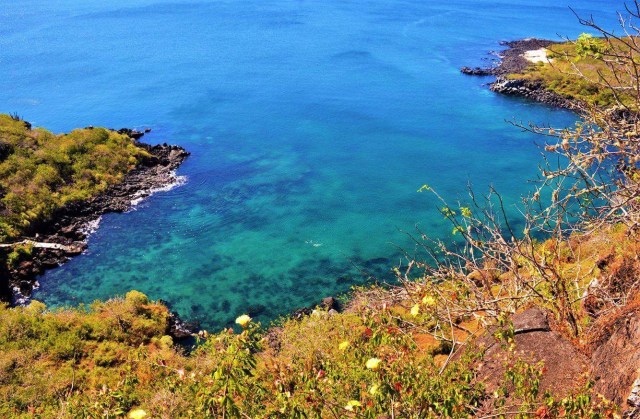
Provides stunning views over the crystal clear water, and it genuinely is crystal clear we could spot sea turtles swimming beneath the surface from up high. Below is a cove that is perfect for snorkelling; we saw sea lions, turtles and lots of different fish. There are also lots of frigate birds flying around this area.

IMG_1182

Punto Carola

Another beautiful Galapagos beach with a little lighthouse at one end. A favourite with the sea lions (they like to sunbathe here and play with the tourists.)

Leon Dormido (Kicker Rock)

The only tour we paid for on the Galapagos was a trip to Kicker Rock ($90 each) as Thomas was desperate to see a hammerhead shark. Lots of tour companies sell trips to Kicker Rock leaving daily and all tend to follow the same sort of itinerary: an hour on the boat to the rock, snorkelling/diving time, lunch on board, and finally some free time at a deserted beach. We saw Galapagos sharks, Black Tip sharks, sea turtles, a manta ray, sea lions, starfish, and huge amounts of other brightly coloured fish. (Unfortunately no hammerheads though much to Thomas’ dismay.)

Food:

Batido de Mora became my favourite drink on this island (basically a kind of blackberry smoothie) and costs around $2.50.

It was a little harder to find cheap food here than on Santa Cruz, however it is possible, and with a little searching we found some places selling the usual rice, meat, salad type combo for about $5. (Avoid the harbour front for the more budget options.) There is also a market and on the second floor they sell lunch for $5.

Summary:

It was a less touristy island than Santa Cruz but the wildlife was more in your face. As we pulled into the harbour we spotted about 10 sea lions and within walking distance from the centre were excellent snorkelling beaches. The town itself is a little limited with fewer choices in restaurants and shops but to be honest that’s not the reason we came to the Galapagos and the amount of easily accessible wildlife on this island makes it my favourite of the two.

The Galapagos on a budget: Santa Cruz

Journey:

We were coming from Montanita so we had to first get a bus to Guayaquil (flights to the Galapagos only go from either Guayaquil or Quito.) CLP located on Montanita’s main highway does direct buses to Guayaquil for $6pp (all the others you have to change at Santa Elena.)

We then stayed one night in Guayaquil and stocked up on things like suncream which we had been warned were very expensive in the Galapagos. We stayed at Dreamkapture Hostel which was perfect for us as it was conveniently located near to both the bus station and the airport (so we wouldn’t have to spend a fortune on taxis.)

The next day our flight was at 9:40am, and before leaving for the Galapagos you have to pay a fee of $20 each. It took roughly 2 hours in flight to reach Baltra Island. There’s nothing on this island except an airport, therefore after getting through passport control, paying the hefty entrance fee of $100, and again having our luggage searched (our luggage was checked about 5 times in total); we then had to get a bus for 10 minutes to get on a boat to do the short crossing to Santa Cruz Island (and I mean short – it was maybe 2 minutes but still somehow cost $1pp.)

On the other side we were given the choice of a taxi for $30 or otherwise a bus for $2 pp (obviously we went for the bus option). The only downside of the bus was that we had to wait an hour for the bus to leave but it wasn’t too much of a hardship. We had some lunch whilst waiting and spotted some sharks swimming around near the cafe. Another 40 minutes later we reached Puerto Ayora and from there a taxi (in the Galapagos taxis are basically pick up trucks) for $2 took us to our hotel.

Accommodation:

Brisas del Pacifico Hotel. Located in the centre of the town it was pretty perfect and at $40 per night a lot cheaper than most other options on the island. The room was massive and could have fit 10 people quite comfortably.

Sights/activities:

Pelican Bay

Near to the harbour there are lots of fresh fish for sale and a lot of birds come along to see if they can get a few scraps too, there are mainly pelicans, but there are also frigates and we saw a heron there too on one occasion.

El Chato Giant Tortoise reserve

Here there are loads of giant tortoises just wandering around and you can wander with them. It’s $3pp which also includes entrance into a lava tunnel (which is averagely cool.) To get here we hired bikes to do the 22km and it took us about 2 hours from Puerto Ayora. It was all uphill and we almost died. Cycling 44km is tough work, but definitely worth it to see the beautiful giant tortoises.

Tortuga Bay

2.5km from Puerto Ayora down a paved path is Tortuga Bay. It’s a beautiful white sand beach filled with wildlife. We saw lots of different birds, including some blue footed boobies flying overhead and many pelicans.

Walking further down the beach there are many marine iguanas sunbathing/swimming. Keep going even further down the beach and there’s a lagoon where we tried to do some snorkelling (but didn’t see anything except a couple of fish as the water was pretty murky.)

Tortuga Bay is also a good surfing spot (or really the only surfing spot you can get to without a boat.) We got here really early and saw it at its most spectacular before the hordes of tourists descended.

Charles Darwin information centre

Just a 10 minute walk from town the information centre gives you a bit of Galapagos background. It also houses some giant tortoises and a few land lizards (although you can’t wander about with them like in El Chato Reserve.)

Laguna de las ninfas

A beautiful lagoon located just before you leave the town to walk to Tortuga Bay. It’s very quiet and you can spot wildlife lurking in the water. We were lucky enough to see two very playful sea lions here jumping in the water.

Food:

We were very nervous about food prices in the Galapagos and thought that we would, probably have to starve. However, this was not the case, there was a street with tables lining the middle and lots of cheap set menus (almuerzos/meriendas – lunch/supper $5.) For this price you were given soup, a main plate and juice.

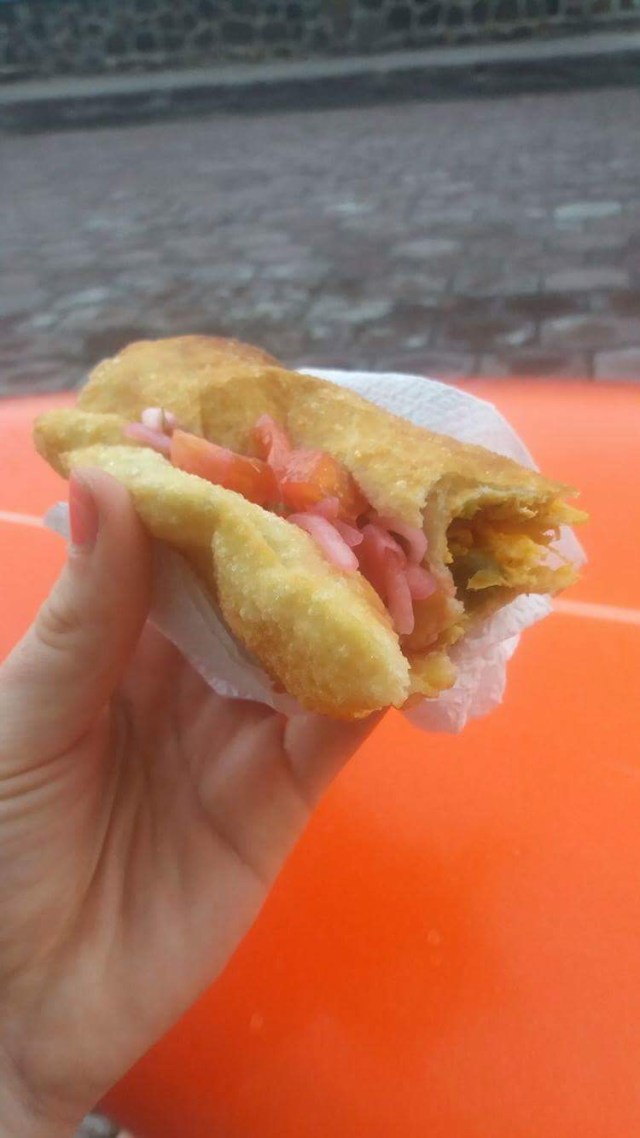
We also found the greatest empanadas we’ve ever had at a small market just outside our hotel. (I tried to take a photo but I got too distracted eating and only remembered half way through my empanada.)

IMG_1119

Summary:

I think it’s practically impossible to not love the Galapagos. There is unusual wildlife everywhere and you can get up close to these animals without having to do a very pricey cruise. Santa Cruz was one of our favourite places so far without a doubt.


Montanita: the home of cocktails and waves

Journey:

This was meant to be a 4 hour journey but instead only took 3 hours (the first time a journey was faster than it was meant to be so we were very surprised.) It cost $6 each and our bus was virtually empty. A very simple journey.

Accommodation:

Hotel Hurvinek. We had originally gone for a different hostel but it was a lot further from the centre so we cancelled and changed to this one. This location was perfect, still in the centre of the town but far enough away from the clubs/bars area that you could get some sleep. It was also really nice and clean (although whenever we stay somewhere for longer than a day we manage to make the room look as big a mess as possible.) Only bad thing was that the beds were really hard. It almost felt like sleeping on the floor. Although, this is apparently meant to be better for your back (?) and I was kind of used to it by the end of our 5 nights.

Sights/activities:

Surfing

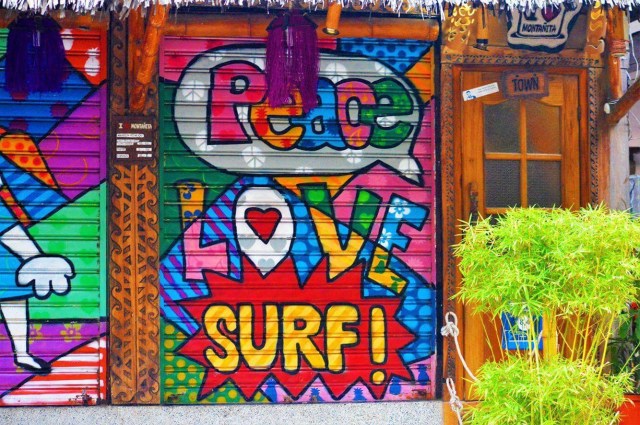
The town is known for being the best surf spot in Ecuador, and the obsessive surfer was thrilled to finally be able to surf. (I mean he had dragged his boards around the whole of Colombia and half of Ecuador now without having much luck so he had earned a few waves.)

There are other surfing spots nearby but we were happy enough to stay at this beach. There are also lots of other activities available, but for us Montanita was a good place to relax for a while, it’s a very lazy little beach town (travelling gets tiring and you sometimes need a few days to recharge – honest!)

Food:

Almuerzos

Sticking to the set lunch menus is definitely he wisest (cheapest) option – you can easily find soup, a main meal, and a drink for $3. Don’t be fooled into eating on the Main Street it’s a definite tourist trap, with food sometimes over $10!

Fish and chips

There’s a decent little fish and chip shop where you can get a portion for $3.50 (although it’s definitely a small portion.)

Pancakes/crepes/juices/omelettes/toasties/fruit salads

Along one of the streets is a row of vendors selling the above range of food (for a maximum of $5.) There’s a huge range of different pancakes (and I tried a fair few of them – obviously), but I think my favourite was either nutella/banana (classic combo) or honey, lemon and sugar (and they are big portions too.)

Drinks:

Montanita is known to be a party town. We were there in low season so it was pretty quiet but still a lot of fun.

Cocktail street

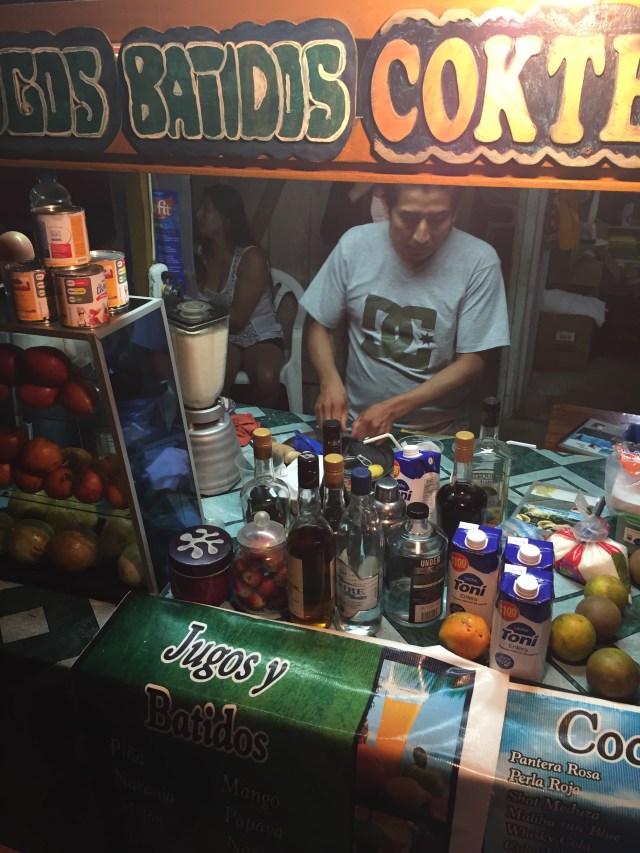
Lining one street towards the beach on both sides are loads of street vendors selling a huge range of cocktails, normally for between $3-$5 per cocktail with very generous amounts of alcohol. The Banana Colada was my favourite by far. The Margarita on the other hand was very bad – I’m not sure if they quite understood that the salt is only meant to go around the edge of the cup and not in the actual drink – so it was a bit too much like sea water mixed with tequila, yummy.

IMG_0894.JPG

Cana Grill

A really cool place with sand in the middle area so it felt very beachy (although it’s really hard to dance on sand as your feet feel really heavy.) There was also live music at the start of the evening, and recognisable tracks later on (something quite hard to come by in South America unless you’re a salsa music expert.)

Summary:

Our favourite place in Ecuador so far (apart from the amazon.) A very laidback beach town, and a nice place to do some surfing and recharge for a few days. Might not have quite the same relaxed state in high season (but I might be wrong), we really enjoyed it here.

IMG_0925

Manta the unmagnificent

Journey:

A pretty long 9 hour journey from Quito cost us $10 each, and another $3 in a taxi to our hotel. The bus was pretty empty though and unlike Colombia we haven’t yet had to pay extra for the surfboard (hooray.)

Accommodation:

Hostel Rosa Mar. There is not a lot of accommodation options in Manta (because there is pretty much no reason to come here.) Hostel Rosa Mar was good for a couple of nights (except for the very patchy wifi) and they were nice enough to refund us when we changed our booking from 3 nights to 2 (after we had very quickly worked out there was absolutely nothing to do.)

Sights/activities:

‘Surfing’:

So when we were planning our trip Thomas made a list of the best surf spots in the countries that we absolutely had to go to. Now on this trip we’ve learnt the thing with surfing is that if you are unlucky (which we had definitely been on this trip where surfing was concerned) there might be absolutely no swell and thus no waves (and when I say no waves I mean no waves.) Consequently, if you’re planning a surf trip you have to be extra flexible with where you want to go as you never know where the good waves are going to be until a couple of days before (or even the day itself.)

Manta is meant to be a great surfing spot in Ecuador and I’m sure if there is surf it’s maybe a more fun area but when we were there (sans waves) it was very boring, and so we made the decision to leave a day earlier. (Apparently the best surf spots are San Mateo and San Lorenzo but we wouldn’t know.)

Playa Murcielago

The most busy beach in Manta (apparently – we went in low season so it was more like completely empty.) It’s nothing to rave about. It’s a kind of average beach. I don’t know what more you can really say here.

IMG_0854.JPG

Montecristo

The only good part of our trip to Manta was going to Montecristo. Just a short taxi drive from Manta ($5), or you can get the bus for very cheap too, sits Montecristo famous for creating the Panama hat.

Mr Fashionista had to get one (apparently I looked like a lesbian in one) and there were masses to choose from. Loads of shops just off the centre sold good quality hats (the better the quality the less transparent they are.) Thomas got a nice one for $50, but the prices ranged from about $20 to $200 or even more. Montecristo was prettier than Manta too so was well worth going to for a couple of hours.

Food:

On our first night we arrived quite late and couldn’t find any where to get some food so ended up eating a couple of empanadas at a restaurant next to our hotel. I don’t know if these were the actual prices or whether we were gringo scammed but we were charged $9 for had 3 empanadas and a drink each which is very expensive (empanadas are really only a snack and in Quito we had paid $3 each for a 2 course meal.) We struggled to find any good, cheap food in Manta, just adding to our dislike for the place.

Summary:

Basically just don’t bother to go here. There are better surf spots in towns with more character so there’s really no reason to go to Manta, other than for a short trip to Montecristo. Although, fun fact: it’s one of the biggest places for tuna fishing and tuna canning in the world. (I mean it’s not really a fun fact but Manta isn’t overly interesting.)

Into the Jungle

Day 1:

We got an overnight bus from Quito to Lago Agrio which left at 10:30pm and arrived at about 4:30am. It was a quick ride, but as always with overnight buses sleep was more of a struggle. We then waited until it was a little lighter (and later) and went to the meeting point, Maytolandia, which was conveniently a restaurant as we were both starving, so we could at least have some breakfast while we waited for our 9am pickup. In the end, it was 10 by the time we set off from the restaurant in a minibus. It was another 2 hours driving, and another 2 hours in a motor canoe before we reached our destinaton of Caiman Lodge in the Cuyabeno National Park. On the way we saw a variety of birds, and an anaconda casually sunbathing on a branch.

After lunch (all meals were provided for us and they were all really good,) we set out again in the motor canoe to see some more animals with our guide Jorge of the Jungle. We were fortunate enough to see an anteater which is quite rare – the last time our guide had seen one was 2 years ago. We then went swimming in the lagoon (which was apparently quite safe although we had just seen some caiman swimming fairly close by so ‘safe’ is questionable) and watched the sunset. As soon as the sun went down it was time to do a night walk, which took us on an hour long trip through the jungle to see a lot of insects – mainly a lot of different spiders.

Day 2:

At breakfast we met the resident bird of the lodge called Carolina, who liked to eat our breakfas and mimic everyone’s laugh (which was kind of creepy rather than cute.)Afterwards, we set off on a 3 hour walk through the jungle to spot some different animals. We also learnt a bit more about plants that were used for médicine or for other purposes by indigenous communities in the amazon. The majority of animals we spotted tended to be more insects, but we also saw a chameleon very well camoflaged.

Late afternoon we again went out on the motor canoe, this time in search of river dolphins (which we didn’t find) but we still managed to spot two different types of monkey, before again swimming in the death pool or ‘lagoon.’ That evening we searched for caiman and snakes in the dark, which was great fun.

Day 3:

In the morning we woke early and at 5:30am took two canoes to do some bird watching. We used paddles this time as the motor canoes tended to scare some of the animals due to the loud noise (this was no easy task though as the oars felt like they weighed as much as a small elephant.) However, after we had got the hang of steering and paddling it turned out to be well worth it as we saw some more monkeys, this time even more close up than before.

After our breakfast half our group left and the other half of us went to visit the Siona Community for the day (which cost us $8 each and was the only thing not included in our trip.) On the way we saw a sloth, finally some river dolphins, and also some more monkeys. We also went to see a ceiba tree, which was absolutely huge, the width of the trunk was maybe 2m.

When we reached the community, we were able to watch one of the women make cassava bread, a type of bread made with only cassava or tapioca as it is more commonly known (a little like a potato.) Thomas loved this bread so much he vowed to make it as soon as we returned to Europe. The shaman of the tribe then came and performed a cleansing ritual and answered some of our questions before we headed back to the lodge. The visit to the community was more interesting than I thought, but still felt a little too touristy and was definitely not my favourite part of the trip.

After visiting the death pool to watch another beautiful sunset, that evening we again went out in search of caiman and snakes and this time saw a big black caiman (it must have been about 4m long.) On the way back we also saw another sloth having its supper (very slowly.)

Day 4:

For our final morning at the lodge we went piranha fishing and after multiple tries I caught one with evil looking orange eyes. After breakfast it was time to leave (just as the rain began) and we spotted a few more monkeys on our return journey. This time we got a private bus for $20 each which took us straight back to Quito in only about 6 hours and also dropped us right at our hostel. This ended up being almost the same price as the public bus would have been as it costs $10 just to get from the historical centre of Quito the bus station.

Our amazon trip was amazing and the highlight of our trip to South America so far. Caiman Lodge was amazing, the staff were all very friendly and our guide was an expert at finding all the different animals (seriously I don’t know how he manages to spot half the animals.) For $290 per person for a 4 day/3 night trip it’s definitely not the cheapest activity but for me it was worth every penny. I would pay double that price to do the trip all over again.

Quito and the Equator line

Accommodation:

Colonial House Hostel. A really nice hostel. I think one of the best so far. It’s a 200 year old colonial house with lots of big rooms, an outdoor area (with hammocks and baby rabbits), a kitchen and lots of other communal areas. The staff were very friendly and let us leave our bags at the hostel while we went on our trip to the amazon (thank god as taking two surfboards to the middle of the jungle would have been a nightmare.) Only thing that would be better is a free breakfast – it’s $3.50 and yes it’s big but I can find an even bigger breakfast in the centre for $2.50 and that $1 you save can genuinely buy you quite a lot here.

Sights/activities:

Free Walking Tour

A good way to get an overview of the Old Town is to sign up for one of the many free walking tours. It lasted two and a half hours and took us round all the main tourist sites and attractions, most of which tended to be churches. The walking tour was good in giving some extra information e.g. one of Ecuador’s contraversial Presidents was murdered with an axe just outside of the Presidential Palace. Although, I think I tend to prefer walking around a new city on my own (especially as they expect a lot of tips – free is a lie.)

Plaza Grande (and Presidential Palace)

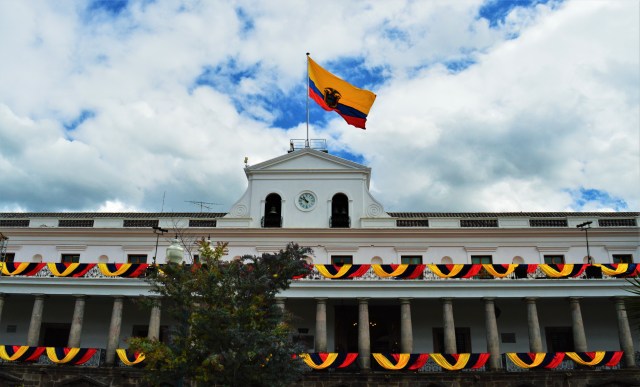
Whilst we were there the President of Ecuador was changing so the square was very busy and brightly decorated with Ecuadorean flags. In general a very pretty square just to do a bit of people watching right in the centre of the Old Town.

DSC_0015

El Panecillo

There is a massive statue of the Virgin of Quito wearing a crown of stars and standing atop a dragon in chains, overlooking the city  from the top of a hill (which you can’t exactly miss.) We took a taxi up to the top (apparently it’s not safe to walk up) and paid $1 each to walk up to the top of the monument. The views over Quito are remarkable and the monument too is an impressive sight. Although catching a taxi back down is quite hard as there are none, and because we are obvious tourists we were charged more on our return journey.

Basilica del Voto Nacional

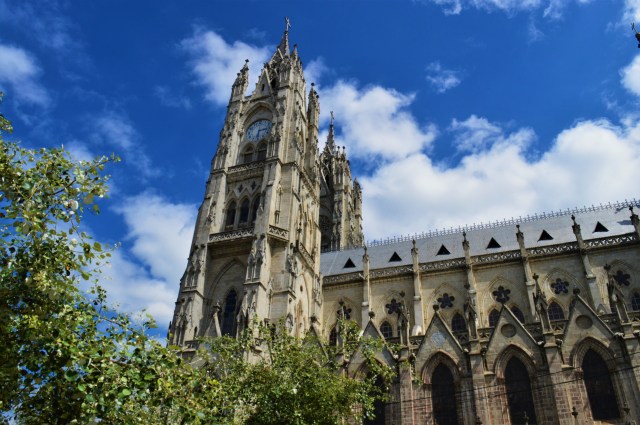
A beautiful structure in Quito’s Old Town. It’s huge, which was kind of helpful as whenever we were a bit lost we could work out where we were by where the basilica was. It costs $2 to climb up to the top of the towers (which is about 40m high) and it definitely feels high, the steps are very vertical and they are outside the main structure (at least for the last part) so it’s not for those who have a fear of heights (Thomas couldn’t quite manage the last stairs.) My favourite touch are the ‘gargoyles’ which are traditional Ecuadorean creatures e.g. Jaguars from the rainforest, marine iguanas from the Galapagos etc. The views over Quito are also very impressive from the the top.

DSC_0001
Equator (Mitad del Mundo)

We did a day trip with Latin American Tours to go and see the equator line (where there’s a museum and monument.) There is really no need to do a tour – we paid a whopping $35 each for basically nothing (our tour guide was really nice but unnecessary – you can definitely do this yourself.) At the museum we carried out some experiments to show the lack of gravity at the equator line so (for instance) you are able to balance an egg on a nail (I mean I wasn’t able to but it’s possible.) 200m away is the monument marking the line of the equator, although this is actually in the wrong place and the real equator line is at the museum.


Food:

So the Old Town during the day is exceptionally busy, yet once you reach the evening everything closes. Therefore, trying to find supper is almost impossible. Fortunately we had a nearby restaurant selling a main meal for about $2.75 but this was quite a rare find (and don’t even try to eat later than 10 as there will be nowhere still open. Apparently the place to go in the evening is La Mariscal (known as the gringo area as that’s where most of the tourists tend to stay.)

However, for lunch and breakfast things are much easier and we found plenty of places doing set menus for about $2.50. One more thing to note: male a visit to one of the many panaderias (bakeries) and get the banana bread. It’s so good.

Summary:

Quito was our first taste of Ecuador. For me, the Basilica and El Panecillo were two very remarkable structures that are definitely worth going to see. The rest was maybe a bit more average. Put it this way, I’m glad I went there and it was an interesting city to visit but would I go back again? Probably not.

Popayan to Quito (via Ipiales)

We decided to split up this journey a little bit (it was still long but more bearable than being on a bus for 24 hours or more.)

For the first leg we got a bus from Popayan to the border town Ipiales. The bus was very small and squashing the surfboard in the back along with the rest of the luggage from all the passengers was a struggle. The bus stopped at Pasto, and we switched to another bus which was again very small so we got to sit upfront with the driver, although this was no hardship as the views on this journey were amazing. In total this took about 8 hours or so and we arrived at Ipiales in the evening.

That evening we stayed at a hotel just off the central square called Hotel Las Vegas, which was 50,000 COP for the night. I’m sure you can find cheaper but this was still pretty good. The following morning we woke up really early to go and see the only thing worth seeing in Ipiales – Las Lajas Sanctuary. It is definitely worth going to Ipiales just to see this church (it’s not your typical South American church by any means and by far the most impressive we have seen to date.)

The church was built in this location after a few miracles occurred here. The first of which was in 1754, when a woman and her deaf mute daughter were hiding from a storm in this area. They saw the image of the Virgin Mary above them and immediately the daughter was cured. Another occurred when a blind man was cured of his inability to see when he visited Las Lajas. Consequently, it was decided that Las Lajas Sanctuary would be constructed here (built between 1916-1949.)

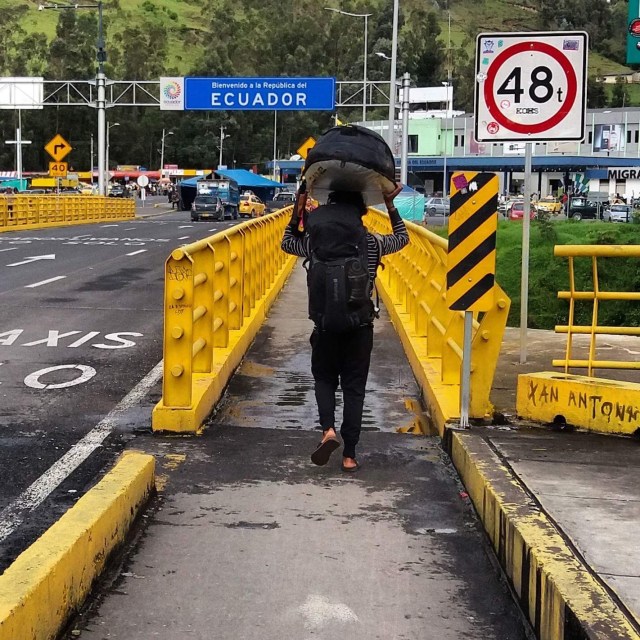
After this impressive (use another word here) pit stop it was time to tackle the border. We caught a taxi for 8,000 COP and ridiculously quickly were stamped out of Colombia (there was absolutely no queue) and we were tricked into believing this would be a fast and simple border crossing.

However, On the other side of the border we queued for about 2 hours to get stamped into Ecuador. The queue didn’t move most of the time so maybe the staff were just taking breaks in between stamping each person?

IMG_0797.JPG

Eventually we were through and got into another taxi to get to Tulcan (about 10 minutes away.) I thought they said 5,000 COP but turns out it was 15,000 (which was confusing as I’d thought I now understood 1-10 in Spanish fairly well but turns out it still needs some work.)

At the bus terminal there was a mad frenzy as a bus driver simply took our luggage before we had even got out of the taxi and sprinted towards the bus. With little choice we ran after them and boarded the bus to Quito (but didn’t have time to explain that we still only had pesos not US dollars – Ecuador doesn’t have their own currency.) Fortunately in the end they accepted 50,000 COP (I mean they had little other choice) and 5 hours later we reached Quito.

Another thing to note is that the centre of Quito is really far away from both bus stations (there are two) and so it costs at least $10 to get there. A taxi driver tried to charge us $15 (gringo problems) but you can definitely get a taxi for $10.

Pretty Popayan

Journey:

This was a very simple journey. We got to the bus station and were immediately put on a bus to Popayan for only 20,000 COP each and no extra for the surfboard. The journey was only 3 hours and the time went by very quickly (except for when a baby was sick on the bus.)

Accommodation:

HostelTrail. This hostel was another good one. Located just on the edge of the colonial area of Popayan it had lots of nice rooms, a kitchen area, fast wifi. It cost 62,000 COP per night for a private room. Nothing bad to be said about it at all (except a free breakfast would be an added bonus.)

Sights:

El Morro de Tulcan 

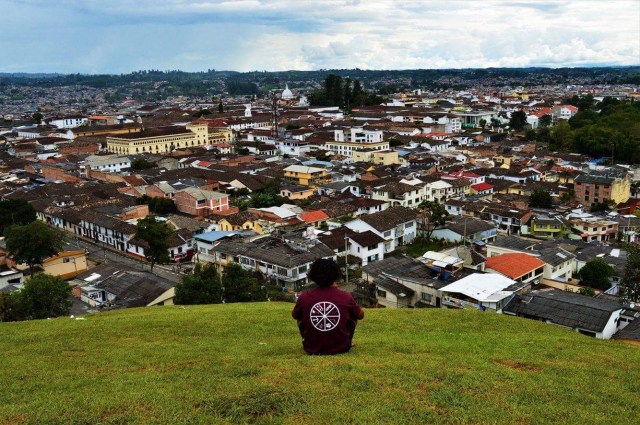
There is a hill just behind the University, which is said to be the sight of a pre-Colombian pyramid. We climbed to the top to get some panoramic views of the city (Thomas wasn’t impressed, he doesn’t like walking – especially not uphill.) It only took about ten minutes up a very steep incline (we’d missed the path and so just ploughed straight up like mountain goats or maybe a bit less gracefully) but the views of the city were definitely worth the pain.

IMG_0792

Parque de Caldas
This is the central square in Popayán, it had a few market stalls, a little park in the centre, and around the edge was the main cathedral and other white buildings (most of which were banks – exciting.) Generally the central area of Popayán was very pretty to stroll through with its perfect colonial architecture.

Puenta del Humilladero

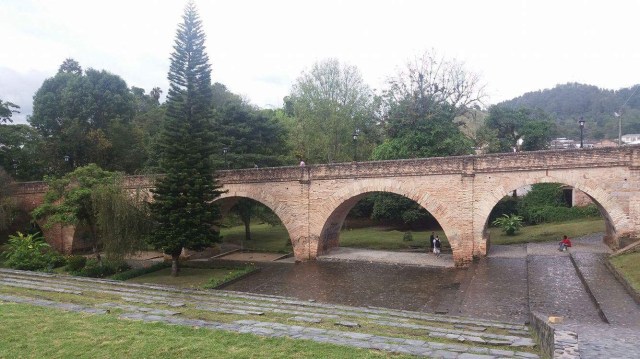
There are two famous bridges in Popayan. The older of the two is the smallest called Puenta de la Custodia and was built to allow priests to cross the river. 150 years or so later the second (Puenta del Humilladero) was constructed. Essentially though these are just bridges and I can’t say are particularly special.

IMG_0778.JPG

Food:

We found lots of places selling a set lunch menu. This was generally a soup, rice, chicken/beef, salad, chips (traditional Colombia – you always have to have two different types of carbs in there at least), juice and a dessert. All for the tiny price of 8,000 COP (maybe $4.) Our hostel tried to direct us to a very touristy restaurant where one price cost 20,000 COP. It looked really good but when you can get double the amount for half the price it’s really a no brainer to try and avoid the tourist spots. Also, they have loads of fresh pineapple on carts everywhere and it’s really good.

Empanadas de Pipian

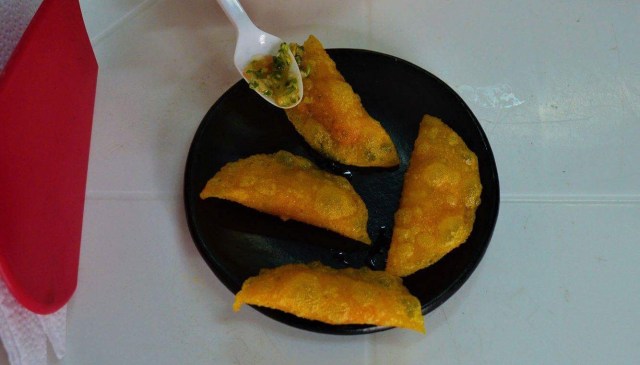
In Popayan they have special empanadas which are basically just very tiny doll-like empanadas. One normal sized empanada is the equivalent of about six mini empanadas so even though they are really cheap you end up eating about ten which makes it about the same price in the end.

IMG_0786

Caramel buns 

In the market in the main square we accidentally came across these caramel buns with raisins on the top (I have no idea whether they have a name) but they were delicious and we ate at least eight between us when we were there.

Summary:

The city was definitely a nice surprise, we hadn’t been expecting too much but it was very beautiful. It is known as ‘the white city’ and it is easy to see why – all the buildings were white and built in the colonial style (with some of the best preserved colonial buildings in the country) with lots of beautiful cathedrals and churches, and also some of the best Colombian food. I would definitely come back again.